Inside Dis-Chem’s digital transformation: the latest from Between the Seams by Stitch
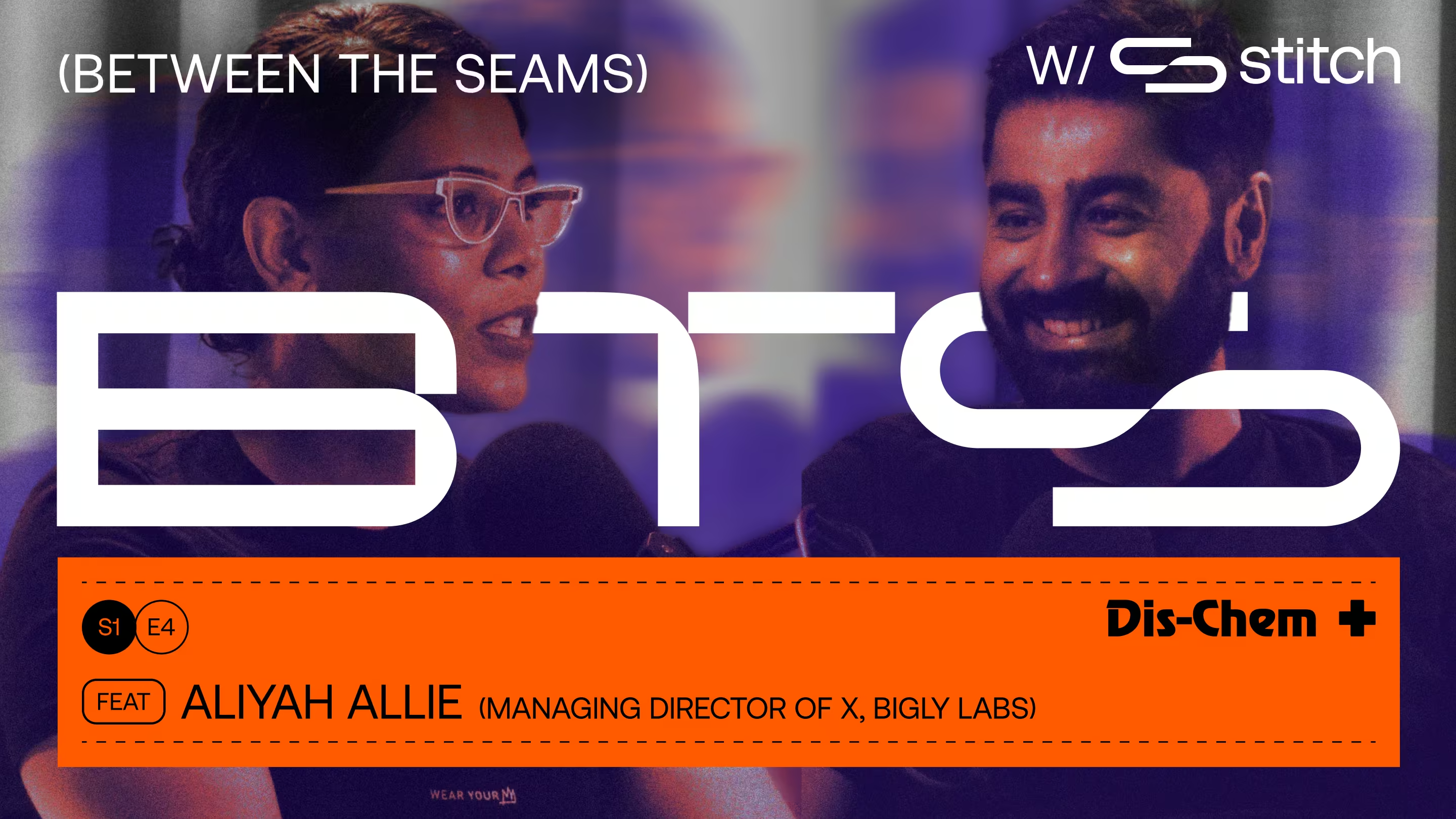
On Between the Seams, Stitch co-founder Junaid Dadan talks to Aliyah Allie from Dis-Chem's X bigly labs about what digital transformation actually looks like inside a 40-year-old healthcare retailer, from replacing a points-based loyalty programme with instant discounts to rebuilding decades-old pharmacy systems and scaling nurse-led clinics across 300+ stores.
South Africa's healthcare system has a strange split: roughly 5% of the population has private medical aid and access to some of the best clinical care in the world. Around 50% relies almost entirely on the public system, which is sophisticated in parts but inconsistent in experience. In between sits a much larger group who earn enough to want better care but not enough to afford a full private plan, leaving them to move between public and private systems depending on circumstance.
This middle segment is the starting point for X, bigly labs, the innovation arm Dis-Chem has built to modernise how it delivers healthcare across its 300-plus store network. In the latest episode of Between the Seams, Stitch President and Co-founder Junaid Dadan spoke with Aliyah Allie, Executive Head at X, bigly labs, about what it takes to build new digital infrastructure inside a 40-year-old organisation, and why some of the hardest problems in healthcare innovation have very little to do with technology at all.
The gap X, bigly labs was built to close
Dis-Chem's pharmacist network and in-store clinics have existed for years as a mainstay of the shopping experience. Allie pointed out that the clinics now run at around 70% capacity, calling them one of South Africa's worst-kept secrets given how close to full they often are. The model is nurse-led, with doctors brought in remotely only when a prescription requires it. A nurse typically spends the time needed to prepare a patient, so when a doctor does join a consultation, often for five minutes rather than the usual twenty, the quality of care holds up while the cost drops sharply.
That cost efficiency underpins a broader ambition: an insurance product that does not require the regulatory complexities of a Prescribed Minimum Benefit (PMB), built instead around Dis-Chem's existing pharmacy and clinic infrastructure. Allie was clear that the goal is not to replace medical aid but to better serve the large group of South Africans currently underserved by both public and private systems.
Building innovation without separating from the core business
A central theme of the conversation was organisational design. Many large companies handle innovation by spinning out a separate unit and letting it run independently. Dis-Chem deliberately avoided that route. Every part of X, bigly labs' work requires close collaboration with what Allie called the Dis-Chem mothership, and the team has been built with the explicit understanding that it will not exist forever in its current form.
"This team needs to exist to fix things up very quickly," Allie said, describing how assets currently held by X, bigly labs will eventually be handed back to the core business, likely within the next three to five years. The friction this creates between innovation and operations is intentional. Dadan drew a direct comparison to our own experience at Stitch launching Express to serve small and medium enterprises. Similarly, this team was kept deliberately separate from the core enterprise business for two years before being reintegrated once it had matured.
Allie credited some of that tension to good hiring. The team mixes engineers and designers with doctors, nurses and pharmacists, ensuring that clinical expertise is represented directly in product decisions rather than bolted on afterwards. She also pointed to long-serving Dis-Chem leaders, including CEO Rui Morais, a 16-year veteran of the business, as a stabilising counterweight to a newer, more disruptive function.
Why the loyalty programme needed a complete rebuild
One of the clearest examples of X, bigly labs' approach came through Dis-Chem's loyalty programme overhaul, launched in October last year. The previous points-based system returned only 1.5 percent of spend to customers, with a further 0.5 percent going to a foundation. Data showed basket size and shopping frequency were actually declining among loyalty members compared with non-members, a clear signal that the old model was not working.
The redesigned programme replaced points with an immediate base discount of 10% across a basket of around 10,000 products. That discount climbs by a further 5% for members of the Capitec Pay loyalty programme who pay with a Capitec card, and by another 5% if the customer has also used the in-store pharmacy that month. Allie was careful to note that the pharmacy-linked discount applies only to front-shop goods, not pharmacy purchases themselves, in keeping with regulations designed to prevent incentivising medication use.
Rebuilding pharmacy software built in the 1970s
Few details in the conversation illustrated the scale of the technical challenge as starkly as Dis-Chem's core pharmacy software. Built decades ago, it remains one of the most complex categories of software to maintain, according to Allie, second only to core banking systems. When she joined the business, only three people in the country knew how to maintain it. One of them was diagnosed with cancer and passed away a few months into her tenure.
That risk had been recognised long before X, bigly labs existed, and a full rebuild is now underway in partnership with an external engineering vendor, with the new system expected to go live in the first quarter of next year. Until then, the team is working to deliver a more modern customer experience on top of legacy infrastructure, something Allie's CTO has described as “taking a donkey to the Durban July.”
Dog-fooding as a culture, not a slogan
Dadan and Allie spent time discussing a shared belief in what they call “dog-fooding” products internally before pushing them externally. At Stitch, the Express team effectively acted as a customer for Stitch Enterprise, which allowed it to expose any frictions and surface any integration problems quickly, which ended up improving the platform for everyone. At Dis-Chem, this takes a more structured form: new features are tested through a company-wide Slack channel where staff are asked to try a product and log issues in a shared spreadsheet, with social pressure used deliberately to drive participation.
"So your business is built on FOMO and shame," Dadan observed. Allie agreed, adding that incentives are roughly equal parts of both.
Where AI fits, cautiously
On artificial intelligence, Allie was candid about the tension many technology leaders in South Africa are navigating. She described being caught between fear of falling behind and fear of moving too fast in a sector where mistakes carry real consequences for patients. Her team has prioritised internal use cases, particularly in software development, over patient-facing applications, and has been more comfortable experimenting with AI in customer service contexts such as WhatsApp than in anything resembling clinical decision-making.
"I continue to be a little bit nervous about AI and what it means," she said, a sentiment that reflects the broader caution running through X, bigly labs' approach to new technology in a regulated, high-stakes environment.
The throughline: solving for the customer
Across topics ranging from regulation to loyalty design to AI, Allie returned repeatedly to a single test: is this solving a real problem for the customer? It is the same principle that led Stitch to separate its Express line for smaller merchants rather than forcing one product to serve fundamentally different customer needs, recognising that an SME merchant requires a far simpler, more self-serve payments experience than a large enterprise managing complex multi-year integrations.
Whether the conversation turned to nurse-led clinics, decades-old pharmacy software or AI guardrails, the underlying logic stayed consistent: build for the customer first, accept the organisational friction that comes with real innovation, and resist the temptation to build technology that looks impressive but solves nothing.
FAQs
What is X, bigly labs by Dis-Chem?
X, bigly labs is Dis-Chem's innovation division, focused on modernising the company's digital, data and customer experience capabilities. It was established to address gaps in South Africa's healthcare system, particularly for the large segment of the population that earns too much for free public healthcare but cannot afford traditional medical aid. Aliyah Allie, Executive Head at X bigly labs, discussed the division's strategy on Between the Seams, the podcast hosted by Stitch co-founder Junaid Dadan.
How does Dis-Chem's nurse-led clinic model work?
Dis-Chem operates in-store clinics staffed primarily by nurses, who currently run at around 70 percent capacity across the network. Nurses handle the majority of a consultation, and a doctor is brought in remotely only when a prescription requires medical sign-off, significantly reducing the cost of care without compromising quality.
Why did Dis-Chem redesign its loyalty programme?
The original points-based programme returned only 2 percent of value to customers and was associated with declining basket size and shopping frequency among members. The redesigned programme offers an immediate 10 percent discount across a 10,000-product basket, with additional discounts for Capitec Pay loyalty members and pharmacy customers.
What challenges does Dis-Chem face in modernising its pharmacy software?
Dis-Chem's pharmacy software dates back to the 1970s and is considered one of the most complex types of software to maintain. The company is rebuilding it from the ground up with an external engineering vendor, with a new system expected to launch in the first quarter of next year.
How is X, bigly labs using AI in healthcare?
X, bigly labs has focused AI investment on internal productivity, particularly within software development, rather than patient-facing applications. Customer-facing AI use, such as chatbots on WhatsApp, is being introduced cautiously given the regulatory and ethical complexity of healthcare.
Why does X, bigly labs operate separately from the core Dis-Chem business?
The team was deliberately structured to maintain close collaboration with the wider Dis-Chem organisation rather than operating as an independent unit. This is intended to create healthy organisational friction that accelerates both innovation and the eventual handover of new capabilities back into the core business.
Get more insights from industry leaders